
The short answer is usually yes, but not without the right permission first. Plenty of homes across Wolverhampton, Tettenhall and Wombourne have a public sewer or a shared drain running under the garden or close to the house, and it is one of the most common things that stops an extension in its tracks when it is found too late. The good news is that most of these jobs can still go ahead. You just need to know what you are dealing with before the digger arrives.
Here is how it works, and how we handle it, drawn from the jobs we run as Tettenhall Construction Services.
How to know if there is a sewer under your plot
Since 2011, most of what used to be private drains serving more than one property became the water company's responsibility. In our area that is Severn Trent. So a drain that looks like it is yours may actually be a public sewer the moment it carries a neighbour's waste as well as your own. You can request a sewer map from the water company, and a good builder will check for drain covers, inspection chambers and the fall of the land before any design is finalised. On the Wightwick job below, the drains did not show up until the footings were dug, which is exactly why we check early on every job near older housing.
When you need a build-over agreement
If your extension will sit over, or within three metres of the centreline of, a public sewer, you will normally need a formal build-over agreement from the water company before you start. This is set out in the Building Regulations, in Approved Document H4, and it is treated as a full plans building control application. Severn Trent, the water company for our area, is clear that building close to or over a public sewer without approval is not allowed, and that they do not issue approvals after the event. So this is a before-you-build step, never an after.
When the answer is no
There are a few cases where a build-over is not normally granted: where there is a formal easement over the sewer, where the pipe is deeper than three metres, on pressurised pumping mains and strategic sewers, and where the work would need piling or ground stabilisation over the pipe. If you hit one of these, the usual route is to divert the sewer instead, which is a bigger job but still doable.
What a build-over agreement involves in practice
Once the design is agreed, the process runs roughly like this:
- A CCTV survey of the drain before work starts, to prove its condition.
- Footings designed to protect the pipe. That often means digging deeper to get below it, or bridging over it with a reinforced concrete lintel so no load lands on the pipe itself.
- Keeping clear access to any manhole or inspection point.
- A second CCTV survey after the build, which is what the water company signs the final approval against. If the survey finds damage, that is put right first.
A real Wolverhampton example
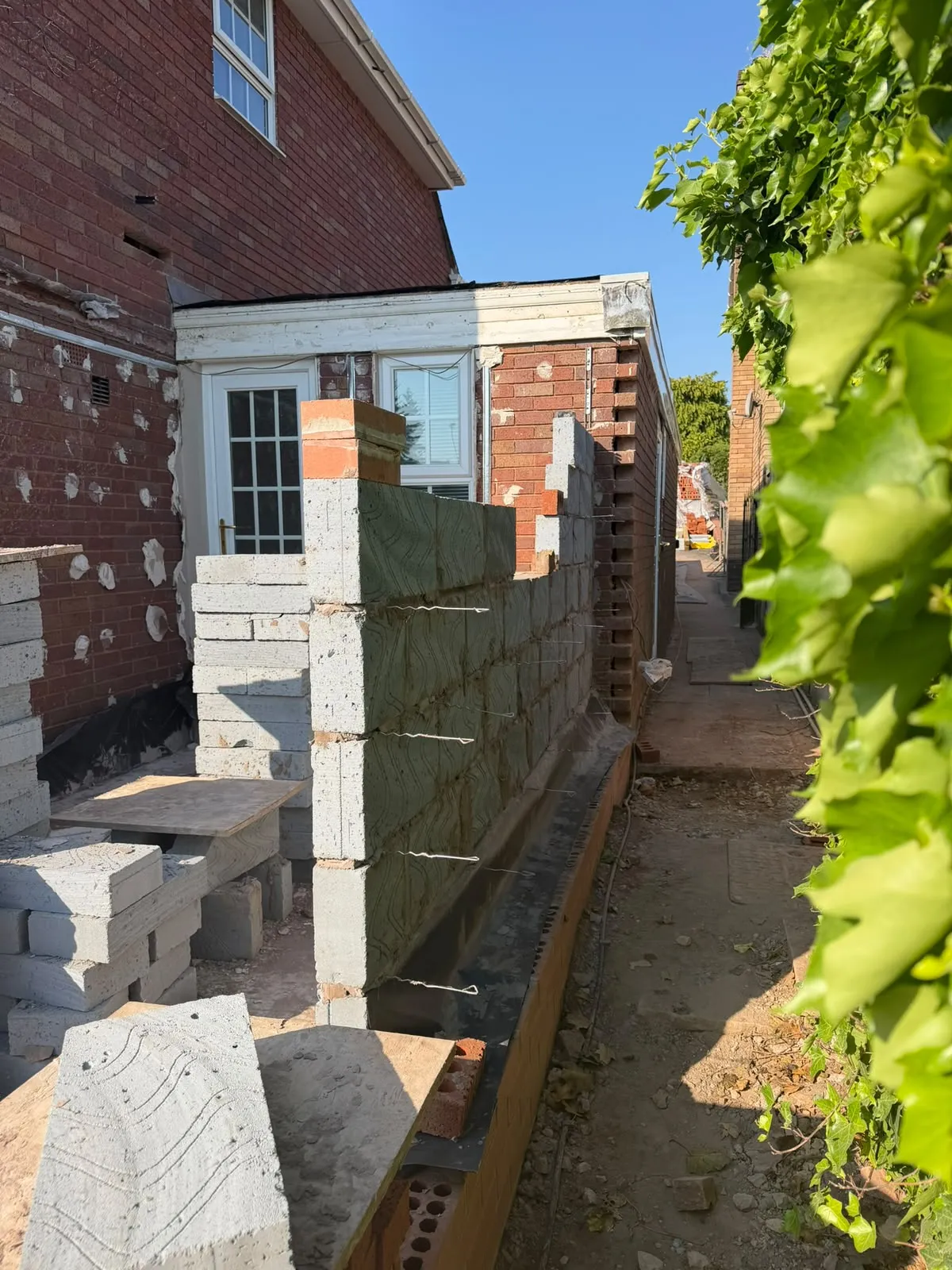
On a recent orangery in Wightwick, digging the footings uncovered two shared Severn Trent drains about 1.6 metres down, running straight under the planned room. Nine times out of ten that is where a project stalls. Because the pipes were under three metres deep, a build-over was possible: we arranged the formal agreement, ran the CCTV surveys before and after, and took the footings deeper to clear the pipes. Both surveys passed, everything was signed off, and the finished room sits over the drains with no problem at all.
What it means for your timescale
A build-over agreement adds a few weeks at the front of a project, so the trick is to start it early and run it alongside the design and planning rather than waiting until the footings are open. Handled from the start, it rarely delays the build. Found halfway through, it can be expensive. We manage the whole process for you, from the sewer check to the final survey. You can see how we run an extension from dig to finish on our projects page.
Frequently asked questions
Can you build an extension over a public sewer or drain?
Usually yes, but not without a formal build-over agreement from the water company first. Building over or close to a public sewer without approval is not allowed, and the water company does not grant approvals after the event, so it has to be sorted before work starts. Once the agreement is in place and the footings are designed to protect the pipe, most extensions over a drain go ahead with no problem.
Do I need a build-over agreement, and who gives it?
If your extension sits over, or within three metres of the centreline of, a public sewer, you will normally need one. It comes from the water company that owns the sewer, which in the Wolverhampton area is Severn Trent. The requirement sits in the Building Regulations under Approved Document H4, and the work is handled as a full plans application through building control. We arrange and manage the whole process for you.
Can you build over a manhole or inspection chamber?
It is possible, but the water company will want reasonable access to the manhole kept, and in some cases the chamber is raised, sealed or repositioned as part of the agreement. Access for maintenance is one of the main things they protect, so a manhole in the footprint needs designing in from the start rather than being built over and forgotten.
What happens if a drain is found after work has started?
You stop and get the agreement in place, because there is no retrospective approval. It is far cheaper and quicker to check for drains and sewers before anything is designed, which is exactly why we look for them at the survey stage on every job near older housing in Wolverhampton.
Not sure what is under your garden?
Tell us about your extension and we will check for drains and sewers before anything is designed, and handle the build-over agreement if you need one. Free, no-obligation quotes across Wolverhampton.